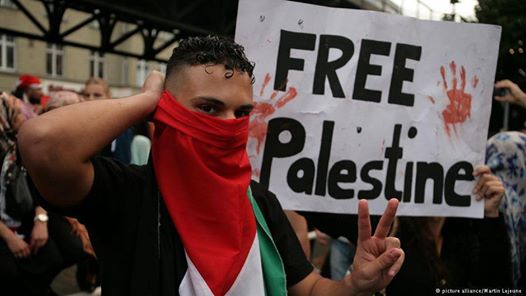
Regularly, red hands can be seen at Pro-Palestinian demonstrations. They can be actually hands painted in red, hands wearing red gloves, or imprints of red hands on signs. Whilst some may mean that they simply signify „you have blood on your hands“, there is an actual story and thus, meaning behind them that goes far deeper.
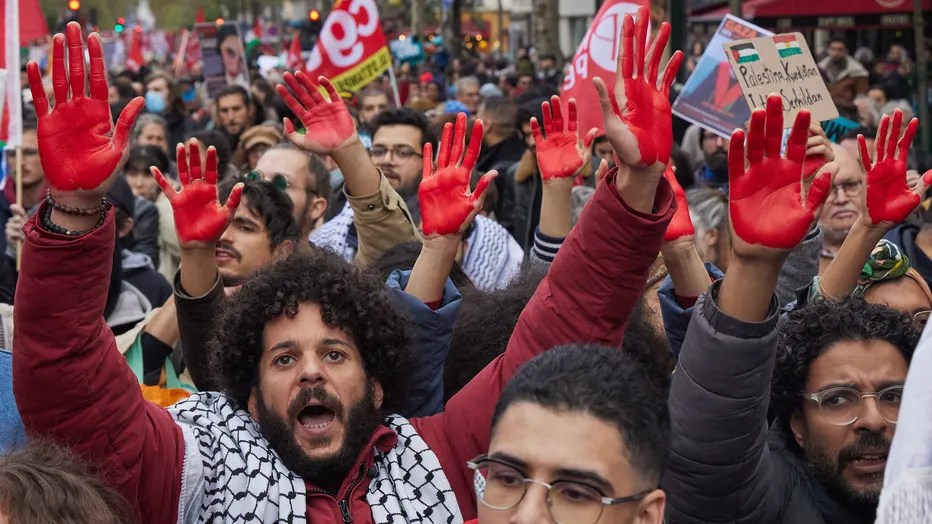
Yes, they have something to do with blood-stained hands indeed…
These red hands refer to the Ramallah lynchings hich took place on October 12, 2000 at the el-Bireh police station.
Two drivers in the IDF reserve, chief sergeant Yossi Avrahami (38), a toy salesman, and corporal Vadim Nurzhitz (33), a truckdriver, returned to duty that day. The two reservist drivers made their way in a civilian vehicle towards their unit’s assembly point near the settlement of Beit El. They had little army experience, were unfamiliar with the West Bank road system and drove through the military checkpoint outside Beitunia and headed straight into the Palestinian town of Ramallah 2 miles east of the checkpoint.
Reaching a Palestinian Authority roadblock, where previously Israeli soldiers had been turned back, the reservists were detained by PA policemen and taken to the local police station at Ramallah’s twin city el-Bireh, not far from Arafat’s headquarters.
The arrest took place at the same time as the conclusion of a funeral service, attended by hundreds of mourners, for Halil Zahran (17), a Palestinian youth who had been killed in clashes with Israeli forces two days earlier. There were lots of tensions as many Palestinians, nearly two dozen of them minors, had been killed in the preceding two weeks in violent protests with Israeli forces in Ramallah.
Rumors spread very quickly that Israeli undercover agents were in the building, and an angry crowd of more than 1,000 Palestinians gathered in front of the station calling for the death of the Israelis. According to the Ramallah station chief, there were 21 policemen in the building. Soon after, Palestinian rioters stormed the building, overcame the Palestinian police and murdered and mutilated both soldiers. Approximately 13 Palestinian policemen were injured while attempting to stop the lynching, whilst at least one participated.
The Israeli reservists were beaten and stabbed. At this point, a Palestinian (Aziz Salha), appeared at the window, displaying his blood-soaked hands to the crowd, which erupted into cheers – there you have the origin of the symbol of the red hands.
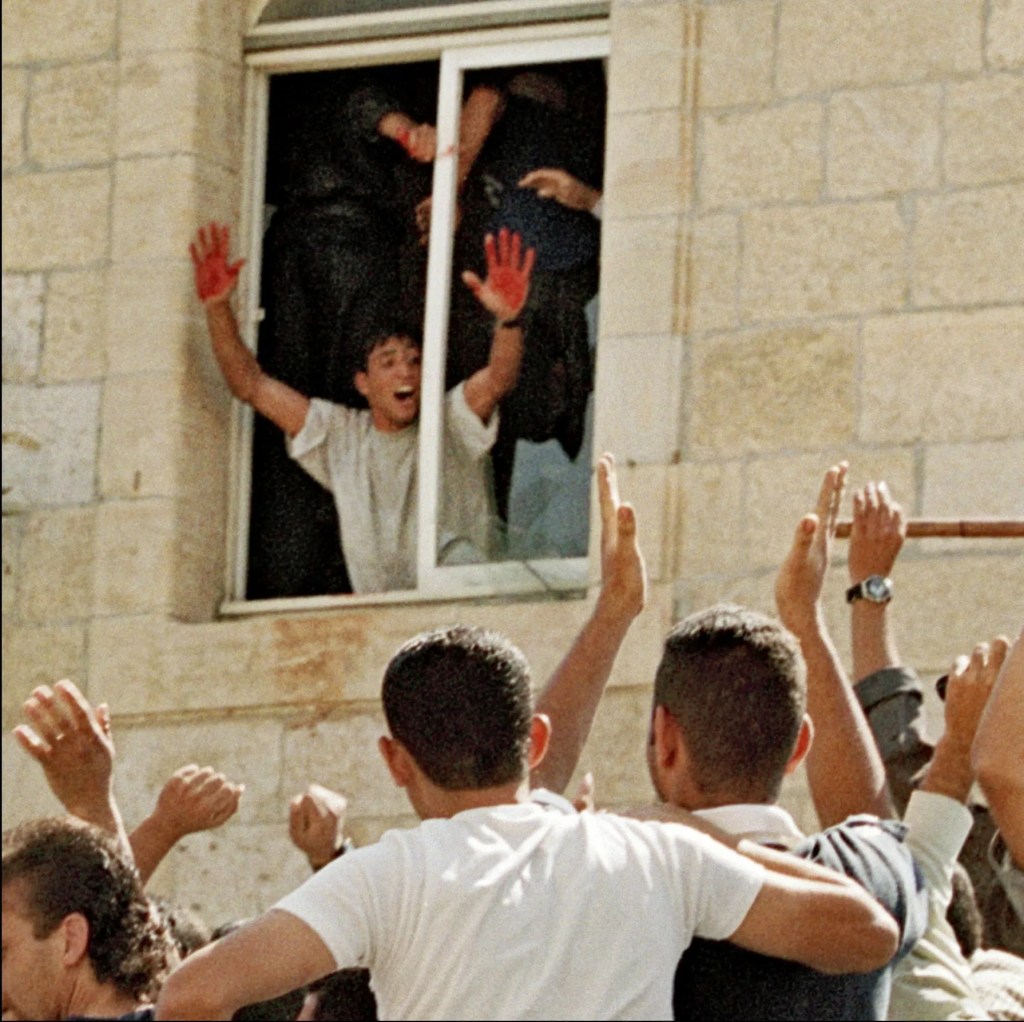
The crowd clapped and cheered as one of the soldier’s bodies was then thrown out the window and stamped and beaten by the frenzied crowd. One of the two was shot and set on fire, and his head was beaten to a pulp. Soon after, the crowd dragged the two mutilated bodies to Al-Manara Square in the city center and began an impromptu victory celebration.
The brutality of the murders shocked the Israeli public, intensifying Israeli distrust of Palestinian Authority Chairman Yasser Arafat. The event also deeply damaged the Israeli left-wing’s faith in the Israeli–Palestinian peace process, at the onset of the second Intifada.
MARK SEAGER, 29, a British photographer, was working on a pictorial study of Palestinian refugees when he found himself caught up in the horrific lynching of two Israeli army reservists in Ramallah. The only journalist to witness the beating, this is part of his exclusive, eyewitness account:
„…I got out of the car to see what was happening and saw that they were dragging something behind them. Within moments they were in front of me and, to my horror, I saw that it was a body, a man they were dragging by the feet. The lower part of his body was on fire and the upper part had been shot at, and the head beaten so badly that it was a pulp, like red jelly…. I thought he was a soldier because I could see the remains of khaki trousers and boots. My God, I thought, they’ve killed this guy. He was dead, he must have been dead, but they were still beating him, madly, kicking his head. They were like animals… I was scared for my life. At the same time, the guy that looked like a soldier was being beaten and the crowd was getting angrier and angrier, shouting „Allah akbar“ – God is great. They were dragging the dead man around the street like a cat toying with a mouse. It was the most horrible thing that I have ever seen and I have reported from Congo, Kosovo, many bad places. In Kosovo, I saw Serbs beating an Albanian but it wasn’t like this. There was such hatred, such unbelievable hatred and anger distorting their faces…. The worst thing was that I realised the anger that they were directing at me was the same as that which they’d had toward the soldier before dragging him from the police station and killing him. Somehow I escaped and ran and ran not knowing where I was going. I never saw the other guy they killed, the one they threw out of the window…. I thought that I’d got to know the Palestinians well. I’ve made six trips this year and had been going to Ramallah every day for the past 16 days. I thought they were kind, hospitable people. I know they are not all like this and I’m a very forgiving person but I’ll never forget this. It was murder of the most barbaric kind. When I think about it, I see that man’s head, all smashed. I know that I’ll have nightmares for the rest of my life.„
So the symbol of these red hands at the Pro-Palestine protests are not just some artistic, or otherwise „peaceful“ symbols, or some more or less innocent way to draw attention to the cause of Peace and well-being of the Palestinian people.
The call here is a whole other one; it is in the same vein as the calls to Intifada and to globalize the Intifada; they are direct calls to violence and death, murder of Israelis and Jews. They do not signify „blood on your hands“ – the context is a whole other one, especially in an Israeli-Jewish context. Not learning history and context does things like this, and simply saying „but“… will not change the legacy of this image and its symbolism.
Now, You know.
 Heilig schräg
Danke lieber Ari, für Deine immer kluge und objektive Art des Betrachtens und Analysierens – und die besten Wünsche Dir für ein gesundes und frohes neues Jahr. Herzlichst UH
LikeGefällt 1 Person
Vielen Dank, liebe Ursula! Dir auch ein gutes neues Jahr.
LikeLike
Vielen Dank ❤
LikeGefällt 1 Person
Gerne 🙂
LikeLike
Pingback: Ledare: När Israel slår tillbaka - idag nyheter