Since Christmas a new thing has been going on in my social media feed. It doesn’t stop these days, there’s something new every few days. This time, as Christmas was approaching, it was about Jesus. This is an opinion piece, not a scientific article. It is born out of tiredness, sadness, anger, and some other emotions. I had to get them off my chest, and it’s been a moment that things have been adding on.
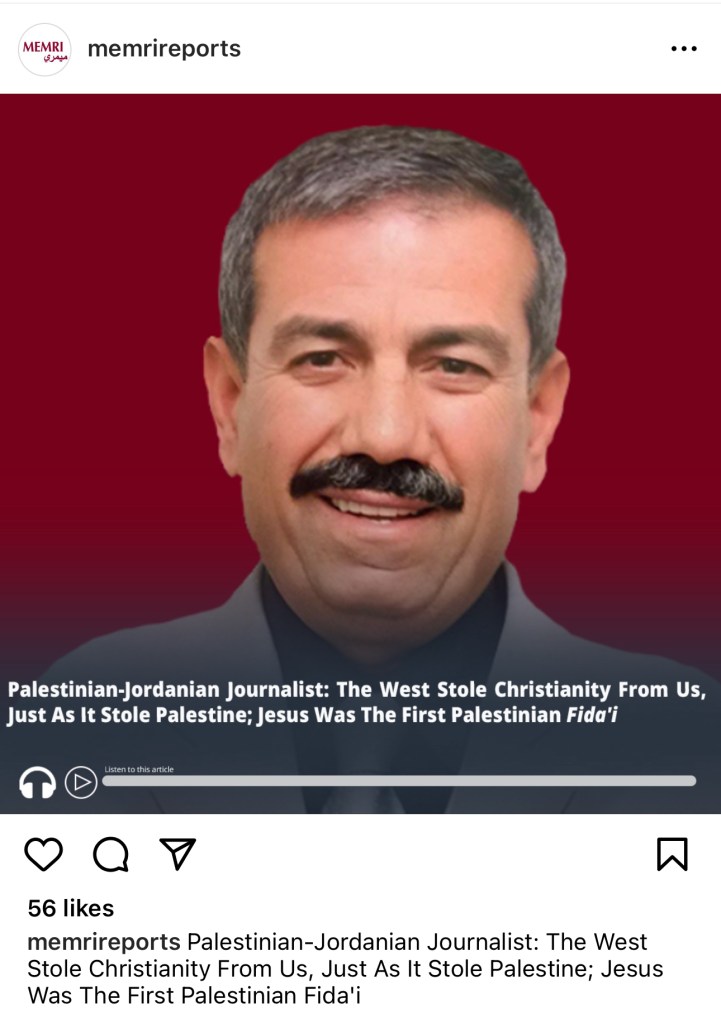
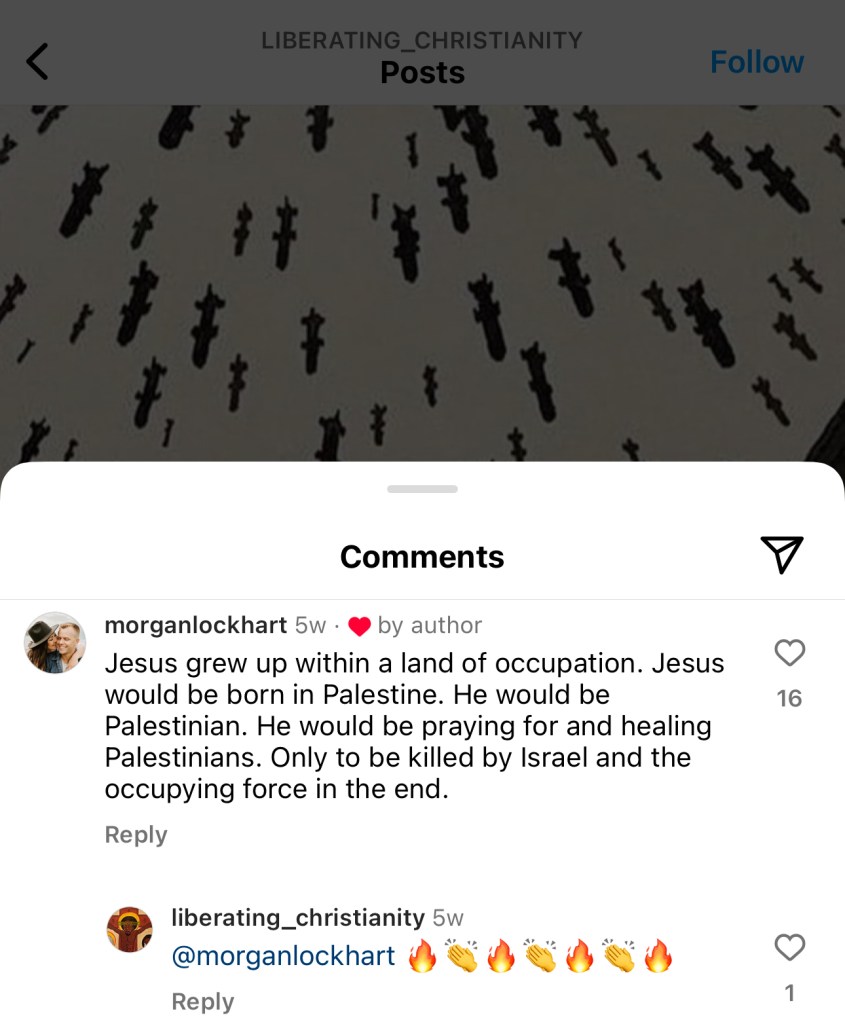
The new thing that is going on (actually, not that new) is that Jesus supposedly is a Palestinian. Actually, the whole thing is ridiculous and sad at the same time. On one hand, I wouldn’t mind, since there are also depictions of Jesus as a black person to illustrate his solidarity with suffering black people for example, or as an indigenous person.
From that point of view, I wouldn’t have been particularly bothered if some of the statements about „Jesus the Palestinian“ hadn’t slipped into anti-Semitism. However, some of the posts were hair-raising and fit quite seamlessly into the good old tradition of other anti-Semitic statements: Jesus would have been born a Palestinian, exposed to child-murdering Jews, later killed by Jews as an adult – same old, same old accusation of deicide (can’t anyone invent something new?) and that this would somehow match the present-day existence of Palestinians who are exposed to genocide by the „fascist colonial state of Israel“, which again murders children full of bloodlust. It’s not difficult to recognize the well-known anti-Semitic myths here in thinly veiled new packaging of course.
Denying that Jesus was a Jew is nothing new – already Joseph Goebbels wrote in his novel „Michael“ that „Christ couldn’t have been a Jew. I don’t even need to prove that scientifically, that’s the way it is.“ Nothing new under the sun.
And yet, against all odds, Jesus was a Jew. He was born and raised as a Jew in Judea, lived in Galilee, lived and practiced as a Jew and died as a Jew in Jerusalem, Judea – condemned to death by the Roman colonial power. The very colonial power which later renamed Judea into Syria Palestine after beating down Bar Kokhbar’s revolt about 100 years after Jesus‘ death. Heck, they even wrote „Jesus the Nazarene, King of the Jews“ on a sign on the cross written in Hebrew, latin and greek (John 19:19-20). There you go.
The whole thing would be less tragic and even simply funnily ridiculous if it were not just another attempt by many pro-Palestine activists to rewrite Jewish history, to undermine it and ultimately make disappear any kind of Jewish roots, identity and links to Israel altogether. This is a trend that is increasing more and more in various forms, though it is not new.
What’s kinda sad about it is that Jesus and his story, like Abraham, could have been a person who unites in this difficult period now rather than divide. Jesus the Jew, who is important for both Christians and Muslims. Jesus the Jew, who first said that he was „sent to the lost sheep of the house of Israel“, but then also took care of others. Jesus who, I am sure, would have grieved over ALL innocent lives, and would have reached out to all who need help, no matter where they are from – Jewish people, Palestinians, Iranians, Sudanese, Congolese, Nigerians – this is something that would have been more worthy, more helpful to to focus on.
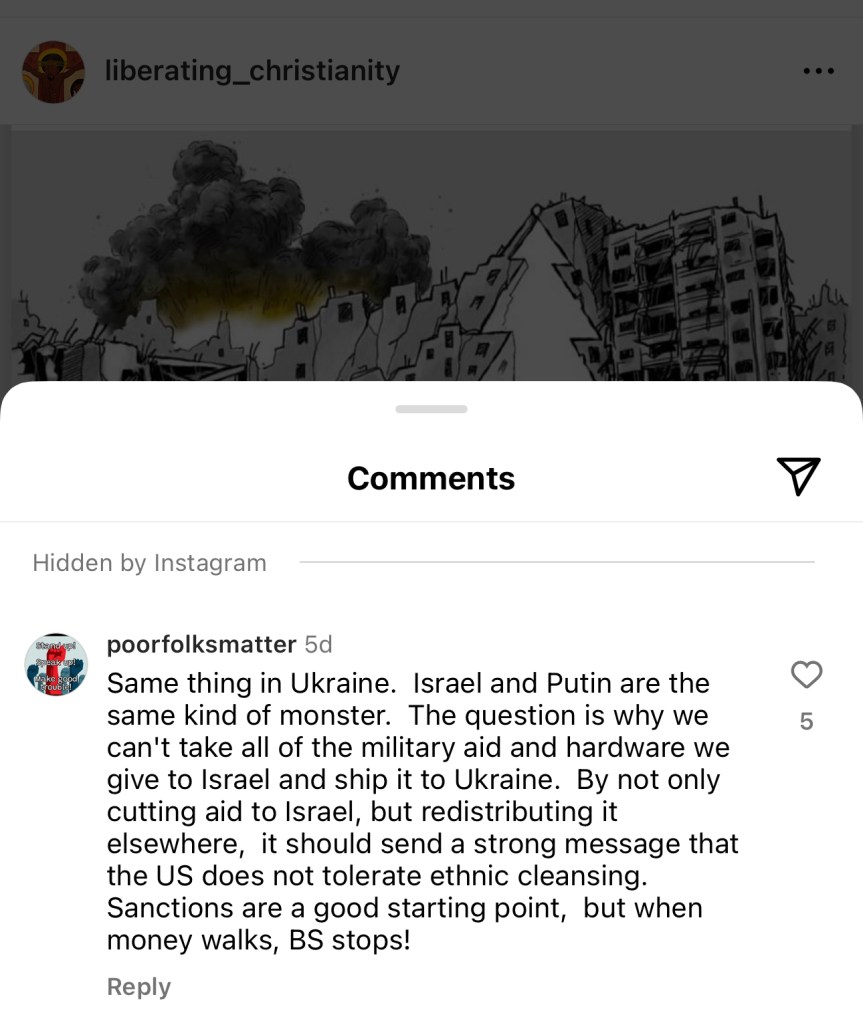
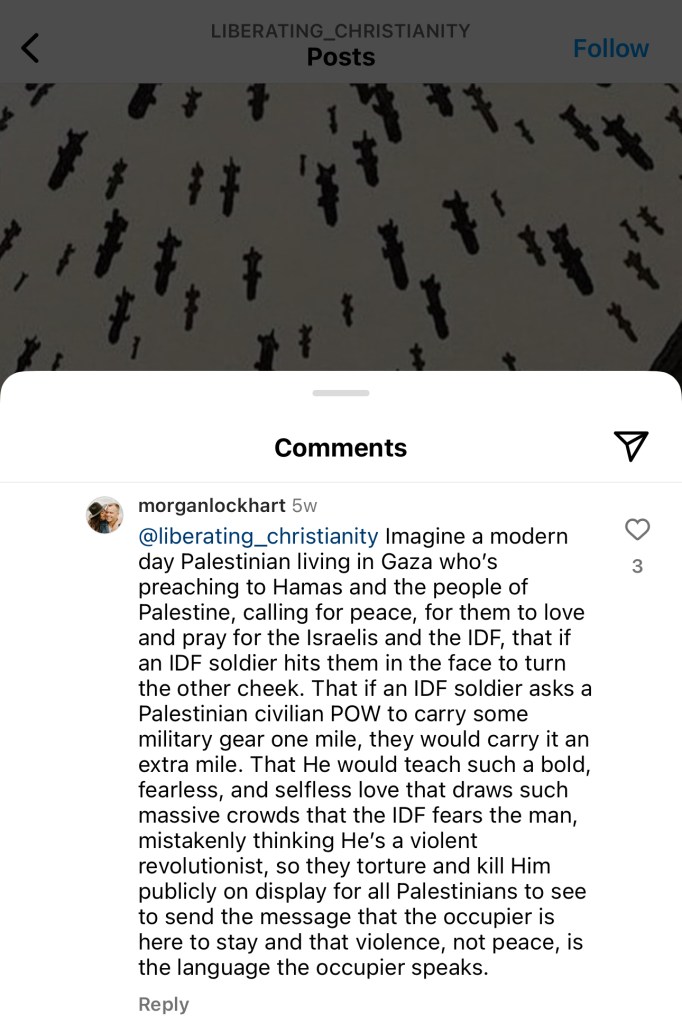
And yet, the likes of Alexandria Ocasio-Cortez and Rashida Tlaib for example chose to invoke the ancient „Jews killed Jesus“ trope in their Christmas instagram posts, and others followed suit. Similar things appeared more or less explicit in some „Christ under the rubble“ posts – troubling nonetheless. After likening Israel/the Jewish State/Zionists/Jews to Nazis and Netanyahu to Hitler, we now have the the Jewish State/Jews likened to the Roman colonial power/Romans who murdered Jesus: the deicide charge is back, the mother of all antisemitic charges used by the Christian Church against Jews – though today largely rejected by modern christian theology.
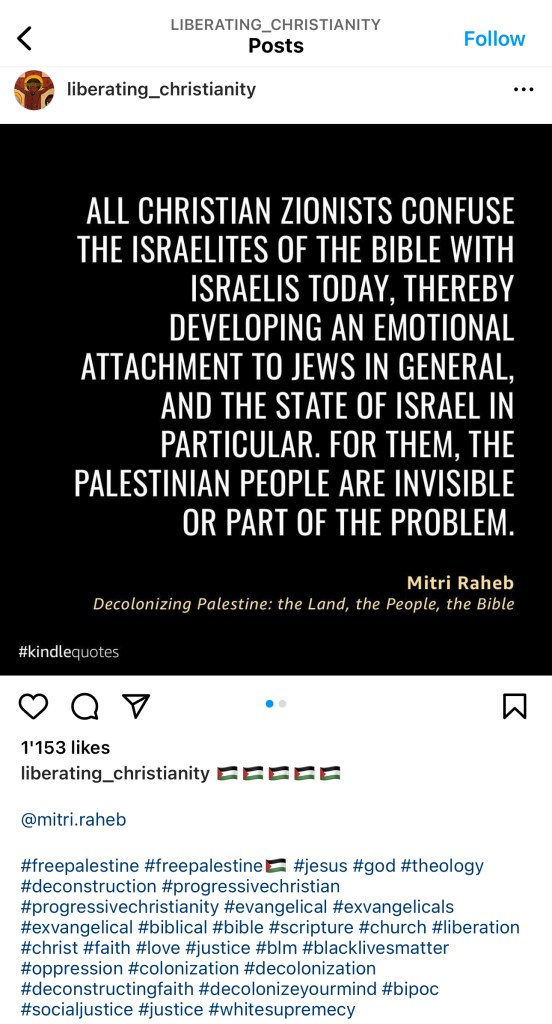
Rashida Tlaib quoted Rev. Prof. Mitri Raheb, pastor of the Evangelical Lutheran Christmas Church in Bethlehem, who speaks of the Christmas story as of a Palestinian story par excellence, equates Roman colonial power with the Jewish State and the Gazans fleeing from the north to the south with Mary and Joseph being ordered to evacuate from the north to the south (which they weren’t – they were simply moving south because of a census, but not being ordered to evacuate or flee because of a war that their government had started).
With all due respect for difficulties and Palestinian suffering, and suffered injustices, revisionist history, recourse to antisemitic stereotypes -especially of the Christkiller and blood libel type- as well are not the way to go. But who am I to talk back to a prize-receiving theologian? Hey, I am just a student, and Zionist.
But what was I to expect from an antisemite?
In 2010, at the „Christ at the Checkpoint“ conference in Bethlehem, Mitri Raheb stated that „Israel represents Rome of the Bible, and not the people of the land„, as well as „I’m sure if we do a DNA test between David, who was a Bethlemite, and Jesus, born in Bethlehem, and Mitri (Raheb, himself), born just across the street from where Jesus was born, I’m sure the DNA will show that there is a trace. While, if you put King David, Jesus and Netanyahu, you will get nothing, because Netanyahu comes from an East European tribe who converted to Judaism in the Middle Ages“ (quote from MILLER TRICIA, Jews and anti-Judaism in Esther and the Church, Cambridge 2015, p. 163). This simply picks up again old racial theories and anti-semitic fabrications like the Khazar theory to say that European Jews are not really Jews and have no connection to the land of Israel, and that Jews altogether are not the true people of Israel.
That’s pretty anti-semitic in my book, struggles or not.
Going further, this makes me think of a a block seminar that I had at university this semester. It was about ecotheology, but one unit was about Palestinian liberation theology. I remember it particularly well because I really struggled with it: it took place in the morning of October 12th, just 4 days after Hamas‘ massacre in southern Israel. I remember because I thought that it was really tone deaf, and had a heard time concentrating on it. I had seen so many horrible images live of people running for their lives, people getting shot, burned, beheaded and raped and spent my nights awake or between awake and nightmare-ridden. And then, one of my professors said that he thought that it was important to give voice to the victims – the Palestinians. At another time, I would have gladly learned about their point of view – but this was not the time. No word about what had just happened at home, no giving context, not much room for discussing – but yes, the famous white-green „land theft map“ that at best, can be construed as a fact-missing half truth, or as an antisemitic lie at worst if seen as Zionists (=Jews as liars, thieves and dominators).
There, we were to read a text by Mitri Raheb, as well as texts by Naim Stifan Ateek, who is a Palestinian priest in the Anglican Communion. Apart from the fact that no context was given, barely room for discussions and explanations – such texts need more time and explanations, and not just putting them there as if there weren’t any large problems with them. Specifically Ateek has problems with what he sees as Zionist interpretations of the Hebrew Bible. One questions that should have been discussed would have been „what are Zionist interpretations of the Hebrew Bible“? Already the term „Zionist“ is very loaded – and from the Nazis to the Soviets to the Iranian Regime, „Zionist“ has just become another word for Jew.
Ateek, born 8 years after the 1929 Hebron massacre in Beisan/Beth She’an, (as well as Raheb) have participated in the elaboration of the Kairos Palestine document. This document has been criticized both by the Simon Wiesenthal Center as well as the Central Conference of American Rabbis, saying that it rewrote history, ignored Jewish roots and presence in Israel for thousands of years and employed replacement theology (saying that the Covenant between G-d and the Jewish people has been superseded by Jesus and Christianity) that denied legitimacy of Judaism and Jews. As such, it rejects the rejects the very notion of a Jewish State – and this is probably what is meant with a „Zionist interpretation of the Bible“ – a continuity between biblical Israel and the Jewish people and the land of Israel, as well as G-d’s promises to Israel and the Jewish people. Those are elements that can be found in today’s Pro-Palestinian activism: denying the links between Jews and their ancestral homeland, and even stating that Palestinians would be the true descendants of the ancient Israelites, as well as rehashes of the Khazar theory.
We were given two texts by Ateek about the Bible, or rather, the so-called Old Testament, the Hebrew Bible, the Tanakh. They are chapters from his books „A Palestinian Theology of Liberation“ and „Justice, and only Justice“.
In chapter 6 of his liberation theology, he writes „One cannot deny that the Old Testament contains material that can deepen our faith and spirituality“ – but otherwise it is worthless? And then goes on to say that other texts contradict principles of human rights and international law (p. 47). Is it really fair, or even sensible to argue about a text written and compiled thousands of years ago in this way? And, the same could be said then, about parts of the so-called New Testament where Paul never bothered to talk about the liberation of slaves but rather sent them back to their slave-holding masters. As he says that those texts from the Tanakh would be offensive to the spirit of Christ, such texts from New Testament are likewise – yet he doesn’t think about throwing them out, rejecting them, or denies them being the „word of G-d“. The texts that are offensive to Ateek, or „us“, he says, „In no way do they constitute a word of God for us. They must be rejected. They have no spiritual or moral value or authority for any person“ (p. 49).
Hybris, much?
Will he say the same for texts concerning homosexuality in the Bible, I wonder? Or only when they concern Israel and the Jews? And this on the grounds that Jesus never quoted from certain books of the Bible. Jesus didn’t quote a lot of Scriptures. Actually, he quoted very little Scripture. Should thus everything he didn’t quote be dismissed? (In that case, Jesus never spoke about homosexuality, trans identity and queerness – therefore, they should not be a problem for any christian, and especially not for Palestinian christians, Ateek, or anyone employing such methods). Difficult texts can be misused. Difficult texts place us before difficulties. They are to be wrestled with. That’s what tradition does.
Where it gets wilder, is the section when Ateek tries to speak about Halakha and his non-understanding of it (when writing a published book that makes such assertions, I expect it to be well-researched and truthful, and to give references and proof. I would be scolded for writing such nonsense in a written work for university).
On page 57 he asserts that „Orthodox religious law differentiates between a Jew and a non-Jew. „The body of a Jewish person is of a totally different quality from the body of all nations of the world.“ Jews are superior to Gentiles. Jewish life has an infinite value; the term human beings refers only to Jews in the Halakha„, as well as a list of other such things.
Obviously Jewish law differentiates between Jews and non-Jews; non-Jews are not bounds to keep the body of mitzvoth (commandments) that Jews are to keep, from prayers to festivals to dietary to other laws. If you were a citizen of Spain who lived in Spain, would you want to have to keep Chinese law? To draw the conclusion from there that Jewish life is worth more than non-Jewish life is more than just a stretch. My guess is that he refers to talmudic discussions without explaining, or possibly even understanding how they function. This is the richness and beauty of Talmud: there are many, many opinions recorded on it, hundreds of discussions on any imaginable topic, even such theoretic cases that they would never have practical application (does anyone know the word speculation?). The beauty of it is that so many opinions and voices are recorded – though none is codified as being „the definite Halacha“ on something. So the things he cites on those pages, calling them Halakha the same way as separating milchig from fleischig is more than far-fetched. And doing this, he goes a long way quoting and citing extremist voices and opinions – that yes, do exist – but none of those that say otherwise. One would not have to search long to find Christians saying similar things about Jews, or Palestinians about Jews for that matter. Extremists are extremists. But that is not his goal: it is depicting Hebrew Scriptures, traditions and the Jewish state as inherently racist and harmful – only to recourse on page 67 again to the theory that modern Jews are descendants of converts without links to the land, the Palestinians being the real people of the land who have never left it (thus also completely dismissing the continual Jewish presence in the land).
Anything is good to demolish Jewish identity, religion, Scripture and links to the land.
Even though Ateek says that the important thing for reading scripture is the hermeneutical key that is used, he still divides the „Old Testament“ into „two distinct strands of religious thought run through the Old Testament. One is exclusive, offering us an ethnocentric (warrior) God and a legalistic and demanding strict adherence to the Law. The other is an inclusive, universal God who loves and embraces al people regardless of their racial and ethnic backgrounds“ (p. 81). It is easy to see which one designates Judaism and the „Jewish G-d“. Things will be taken further in the chapter of his other book, Justice and only Justice. They hermeneutical key that he proposes is Christ, and reading Scripture through the lens of Christ, encouraging passages to be left out if they do not conform: Christ is the word of G-d and not the Bible.
Chapter 4 of „Justice and only Justice“ starts out with a quote by Arnold J. Toynbee that states that for him, „Israel“ in the Bible never had anything to do with a physical Israel or the Jews, but rather with those who worship the One true G-d and obey him, but that nowadays the word „Israel“ in the singing of Psalms and such pulls up uncomfortable pictures: „a middle-Europe type state, with bickering political parties like all such states, with a rigid and unsuccessful—foreign policy with respect to its neighbours and with constant appeal to the Jews of the world either to send them money or to come themselves… The present-day political Israel has, for all
of us, obliterated or, at least, adumbrated, the spiritual Israel of the Judeo-Christian tradition. This is surely a tragedy“ (p. 76). There we have the money-hungry Jew… And rather have a „spiritual Israel“ that stays theoretical and whose place anyone can take, than actual Jews who are a constant reminder that they were there first, and that these are in fact, our Scriptures, first of all.
Ateek seeks to build a Palestinian liberation theology that addresses the political and social systems that are obstructing justice and reconciliation between Israelis and Palestinians, and seeks to change those toward social and political patterns that will express just relationships – whilst at the same time rejecting jewish understanding of the Bible that link Jews to Israel or affirm continuity between the biblical people of Israel and the Jewish people, Am Yisrael. As soon as this is done, the Hebrew Scriptures become „repugnant“ and their status as „Word of G-d“ are doubtful:
„Since the creation of the State, some Jewish and Christian interpreters have read the Old Testament largely as a Zionist text to such an extent that it has become almost repugnant to Palestinian Christians… The fundamental question of many Christians, whether uttered or not, is: How can the Old Testament be the Word of God in light of the Palestinian Christians‘ experience with its use to support Zionism?“ (Justice and only Justice, p. 77) Clearly, there are uses of text that cannot be justified – radical settlers shooting Palestinians on sight simply because they are Palestinians cannot be justified by anything, and has nothing to do with text but with their violent character. Such actions have to be condemned and need to have consequences for the perpetrators. However, it cannot be a criteria for the text to be expunged or not from being ‚authentic‘ or „Word of G-d“ because the text in question can be used to support Zionism, that is, Jewish self-determination and a Jewish homeland, supporting Jewish indigeneity to Israel-Palestine.
Wanting to expunge or purge texts in one matter or another, or declaring that „In no way do they constitute a word of God for us. They must be rejected. They have no spiritual or moral value or authority for any person„, and speaking of the G-d of the Tanakh in terms of „primitive tribal conception“ versus the universal G-d of love of Jesus reminds me a bit of Marcion. Not to say that there is identity – but Marcion popped into my mind. Marcion of Sinope lived approx. 85 – 160) and was a theologian of the early Church. According to him, the god of the Old Testament is a jealous tribal deity of the Jews, whose law represents legalistic reciprocal justice and who punishes mankind for its sins through suffering and death. In contrast, the God that Jesus professed is completely different: a universal God of compassion and love who looks at humanity with benevolence and mercy. Macron also composed his own biblical canon completely devoid of the Jewish scriptures, and with only select writing of the New Testament (those that he judged devoid of Jewish Influences, to simplify things). Nothing new under the sun, even if it may be for different reasons.
Thus, Naim Ateek searches for a hermeneutic to identify the authentic Word of G-d in the Bible, and discern the true meaning of those biblical texts that Jewish Zionists (=Jews) use to substantiate their claims (claims of being Jews, that is, being who they are, namely a. connected and descended from the people of Israel in the Bible and b. being connected to the land), as opposed to inauthentic Words of G-d in the Bible and false meanings. The true meaning of those texts that he wants to find would be to disprove those claims, or to substantially weaken them – is what I read into this. „Palestinian Christians are looking for a hermeneutic that will help them to identify the authentic Word of God in the Bible and to discern the true meaning of those biblical texts that Jewish Zionists and Christian fundamentalists cite to substantiate their subjective claims and prejudices„, (Justice and only Justice, p. 79).
For him, this hermeneutic is looking at Scripture through Christ. This is nothing new, and has been done very much throughout the history of christian theology, from the beginning of the Church until now:
„Things become clearer when we apply this hermeneutic to specific biblical texts. There are certain passages in the Old Testament whose theological presuppositions and even assertions need not be affirmed by the Christian today, because they reflect an early stage of human understanding of God’s revelation that conflicts with the Christian’s understanding of God as revealed in Jesus Christ. Although these passages need not impose particular doctrinal views or obligations on the contemporary Christian, they remain valuable pedagogically. Their value lies partially in their negative aspect: they clarify what God is not, as much as what God is. They offer the Christian a picture of God that contradicts the way God has come to be understood and known through Jesus Christ. Viewed from this perspective, the whole Bible is valuable, but not all of its parts have the same value and authority.“ (Justice and only Justice, 82-83)
This is nothing new, and the Church has always done this: either the Hebrew Scriptures have only been seen useful as a sort of depository of prophesies pointing to Jesus that were then fulfilled and thus not really useful anymore, or been seen in a „the Law as a pedagogue“ mode. Both don’t do the Hebrew Scriptures justice and are simply an expression of christian supremacy. Antisemitism has deep roots in christian supremacy – even though here, both seem to nourish each other, fueled by pain.
And why should reading the Tanakh (Hebrew Bible) with Christ as hermeneutical key be of any pertinence to Jewish interpretation, since part of his problem is with „zionist“ (=jewish) biblical interpretation? Christ is absolutely irrelevant here.
And it is Jewish Scriptures we are talking about, the Christians have inherited from their older Jewish brethren. It is not up to christians to tell Jews how to interpret their own Scriptures, or up to christians to try and separate Jews fron their heritage and tradition, and misappropriate them in return. Supercessionism aka replacement theology is antisemitic to the core.
On page 166, Ateek writes that, „The preservation of Israel as a Jewish state is important not only to Israeli Jews but to Jews all over the world. I believe that we must honor their wish and accept it. In fact, the Palestinians should eventually guarantee the survival of Israel by accepting it as a Jewish state„. He concedes to the existence of Israel, but not because our home has the right to exist – rather, that it needs to exist now because of the millions of Israelis living in it. Also, he condemns suicide attacks but at the same time says that they are the result of Israeli occupation – the product of its own making.
What is missing to me here is a sense of taking a part of own responsibility. Israel is not innocent, has made mistakes; radical settlers must be taken care of. But this something that has struck me these days, from the attacks to now: a seemingly complete lack of any type of condemnation, or taking responsibility for wrongdoing or own failures. Instead, a redoubling in blaming Israel, Zionists, and Jews in general for faults that Jews have made and those that they have not made; a redoubling in effort for rewriting history, trying to cut Jews off not only from the land, but out from their own history, traditions, stories and wherever and whatever is possible; from something as ridiculous as food recipes to construing a minority that make up 0.2% of the worlds population as the most powerful elite that either reach for world domination or already control the entire world, down to making Jesus Palestinian and Moses Muslim.
All these things… seem to simply serve to delegitimize the Jewish people’s continuing Covenant with G-d and repeat the argument that our Covenant has been superseded by Jesus and Christianity. The „Christ under the rubble“ posts have in part picked up dangerous Christ-killer tropes that, in the history of christianity have led to the demonization, persecution, and killing of Jews just as the blood libel myths have led to pogroms. The State of Israel often serves as the personified Jew, if it is not Jews directly that are demonized – the lecture of comment sections is from saddening to sickening, and not all the people who post these things are strangers. What a feeling when one sees friends and acquaintances, or your doctor post and like such things!
What a feeling, when you try to keep your heart open on all sides and feel compassion for all those who suffer.






 Heilig schräg